A sewage backup in a Rockville home is a health hazard, not a mopping job. The safe first steps, the mistakes that spread contamination, and how professional cleanup works.
The fast answer: treat it as contaminated, keep people out, call the same day
If sewage has backed up into your Rockville home — through a basement floor drain, a toilet, a tub or a laundry sink — treat every drop as contaminated water, because it is. Keep children and pets out of the affected area, do not walk through it and then through the rest of the house, stop using the fixtures that feed the problem, and get a professional cleanup started the same day. Sewage carries bacteria and other pathogens, and porous material it touches — carpet, pad, drywall, insulation, cardboard — generally cannot be cleaned back to safe and has to come out.
Backups in Rockville tend to announce themselves the same few ways: a floor drain in a Twinbrook or King Farm basement that rises during a heavy rain, gurgling toilets on the lowest level, or a sewer smell that gets stronger whenever water runs upstairs. Whether the cause sits inside your home or further out in the line, the cleanup rule does not change. Eagle Water Damage Restoration answers 24/7 at (855) 809-6899, assessments are free, our technicians are IICRC-certified, and we bill insurance carriers directly for covered work.
Why Rockville homes back up — and why the lowest fixture goes first
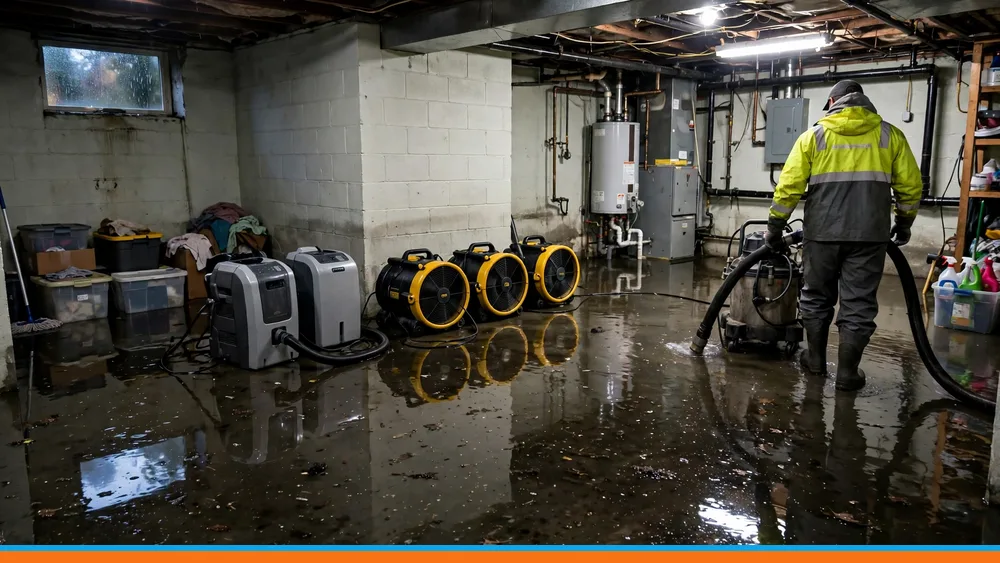
Sewage follows gravity and pressure, so it appears at the lowest opening it can find. In a Rockville split-level or colonial, that is usually the basement floor drain, a basement bathroom, or a laundry tub — which is why a backup can be well underway downstairs while the kitchen and baths above still seem to work normally. Every flush and every load of laundry run after that point adds volume to a line that has nowhere to send it, and pushes contaminated water further across the floor.
The causes fall into two groups. Inside the home, tree roots entering an older sewer lateral, a collapsed or offset section of pipe, grease and wipes building up in the line, or a failing ejector pump can all slow or stop the flow. Outside the home, a heavy Montgomery County storm can surcharge the shared system so that water looks for any lower opening — including yours. Sorting out which side of the property line the problem sits on matters for who repairs the pipe, but it does not change the first job: the contaminated water and everything it soaked have to be handled safely, and documented while the evidence is fresh.
The first hour: what to do, and the mistakes that make it worse
Start by limiting exposure and spread. Keep people and pets out of the affected rooms, and if you must cross the area, wear boots and gloves and remove them at the edge of it so contamination is not tracked onto clean floors and stairs. Stop running water in the home — no flushing, no laundry, no dishwasher — until you know whether the line is moving. If sewage is near outlets, a panel or appliances, switch off power to those circuits from a dry spot at the breaker box, and never stand in the water to unplug anything. Photograph the affected rooms, the drain or fixture it came from, and the waterline before cleanup changes the scene.
Then avoid the three mistakes that turn a contained backup into a whole-house problem. Do not mop sewage with household towels and then carry them through clean rooms to a washer — that spreads contamination along the whole route. Do not run fans or the HVAC system to dry the area, because moving air over contaminated water spreads residue and odor into ducts and clean space. And do not pour bleach or chemical drain cleaner into a backed-up line and keep flushing: it does not clear a blocked or surcharged line, and it adds a chemical hazard to a biological one. A shop vacuum is not the answer either — ordinary household equipment is not built for contaminated water and becomes contaminated itself.
How professional sewage cleanup actually works
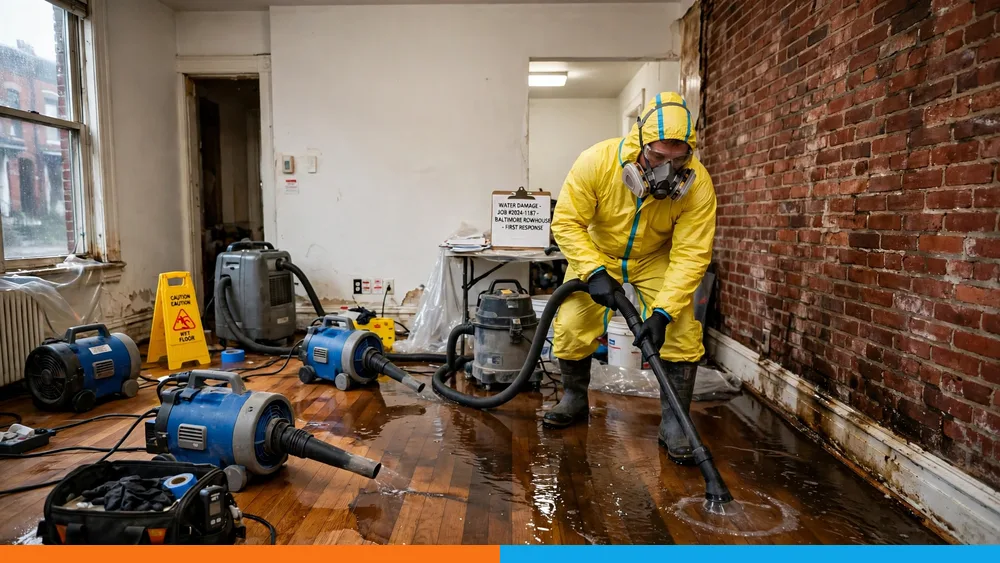
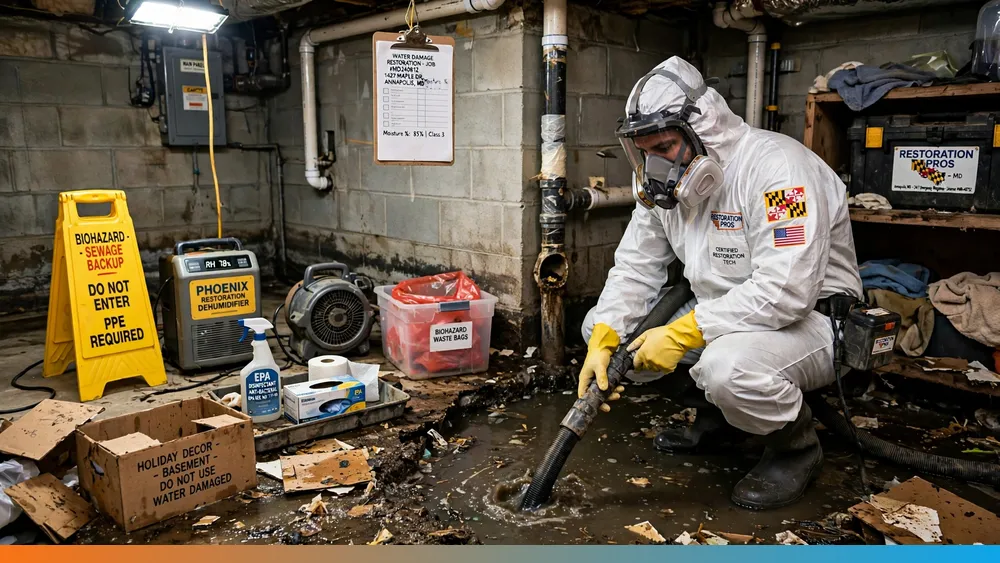
A proper job starts with protection and containment. Our crews work in protective equipment, seal off the affected area so the rest of the home stays clean, and extract the standing sewage with equipment made for contaminated water. Porous material the sewage reached — carpet and pad, the bottom of affected drywall, wet insulation, swollen particleboard — is removed and bagged for disposal, because no surface treatment makes a soaked porous material safe again. Hard surfaces that remain are cleaned and then disinfected, and anything that cannot be restored is documented item by item for the claim.
Only after the contamination is gone does drying begin, and it runs the same disciplined way as any water loss: moisture is mapped with meters and thermal imaging, structural drying runs to verified targets for each material, and readings — not appearances — say when the job is done. That order matters. Drying a room that has not been properly cleaned and disinfected simply fixes the odor and residue in place, and a Rockville basement that smells fine in November can announce itself again on the first warm, humid day of spring. The photo record, moisture log and itemized scope we produce are the same documents your carrier reviews.
Prevention, the insurance picture — and when to call
Some backups can be made less likely. Never flush wipes — including the ones labeled flushable — paper towels or hygiene products, and keep grease out of the drains, where it cools and narrows the line. If your home has backed up before, ask a plumber about a camera inspection of the lateral and about a backwater valve, which is designed to stop flow from reversing into the house during a surcharge. Know where your lowest fixtures are and treat early warnings — slow drains on the lowest level, gurgling when a toilet flushes upstairs, a sewer smell near the floor drain — as a call to investigate, not background noise.
On coverage, sewer and drain backup losses commonly turn on a specific endorsement rather than the base policy, which makes the dated record — photos, the source, receipts for emergency work — even more important; a complete record gives the claim its strongest footing either way, and we bill carriers directly for covered work. If sewage has backed up in your Rockville home today, do not mop it, fan it or wait to see whether it drains on its own. Call Eagle Water Damage Restoration at (855) 809-6899 or send the lead form on this site. We answer 24/7 from nearby Beltsville, assessments are free, and our IICRC-certified crews handle extraction, removal, disinfection, structural drying and the insurance documentation as one documented job.
Need This Handled?This guide covers Biohazard Cleanup & Disinfection — the service behind this article. Free assessments, 24/7 response across Maryland: (855) 809-6899 or read about the service.
Water Damage Can't Wait — Neither Should You
Every hour of standing water means more damage and a bigger repair. Request your free assessment online and we'll call you back to confirm — or call now and a coordinator will dispatch a crew.