Baltimore rowhouses dry differently: shared party walls, plaster and lath, and century-old hardwood all hold water longer. How proper structural drying works in the city's attached homes.
The fast answer: a rowhouse is not a detached house with less yard
If a pipe, roof or appliance has soaked your Baltimore rowhouse, the drying job is different from a detached home in the suburbs — and it starts the same way: stop the source, extract the standing water, and get the structure measured, not guessed. Rowhouses share walls with the neighbors on both sides, carry plaster-and-lath or early drywall that drinks water slowly and gives it back even more slowly, and sit on hardwood and subfloors that may be a century old. A fan in the middle of the room does not dry any of that.
That holds from Federal Hill and Fells Point to Hampden, Canton and the rowhouses of West Baltimore: the water travels sideways into the party wall and down through floor assemblies that were built before vapor barriers existed. Eagle Water Damage Restoration answers 24/7 at (855) 809-6899, assessments are free, our technicians are IICRC-certified, and we bill insurance carriers directly for covered work.
Why party walls change the whole drying plan
In a detached house, water in an exterior wall has one cavity to fill. In a rowhouse, the two long walls are shared — brick party walls that separate your home from the one next door — and brick and mortar absorb water and release it slowly, over weeks if nobody is measuring. A leak that starts in your kitchen can show up as a damp party wall two rooms away, and moisture that migrates into the shared wall can affect the neighbor's side as well, which is why documenting where the water went matters to more than just your own claim.
The framing tells the same story. Many Baltimore rowhouses carry balloon framing or floor joists pocketed directly into the brick, so water that enters a floor assembly can travel along joists and appear in a ceiling far from the source. Our crews map that travel with moisture meters and thermal imaging before a single air mover is placed — in an attached home, the moisture map is the job.
Plaster, lath and old hardwood: slow to wet, slower to dry
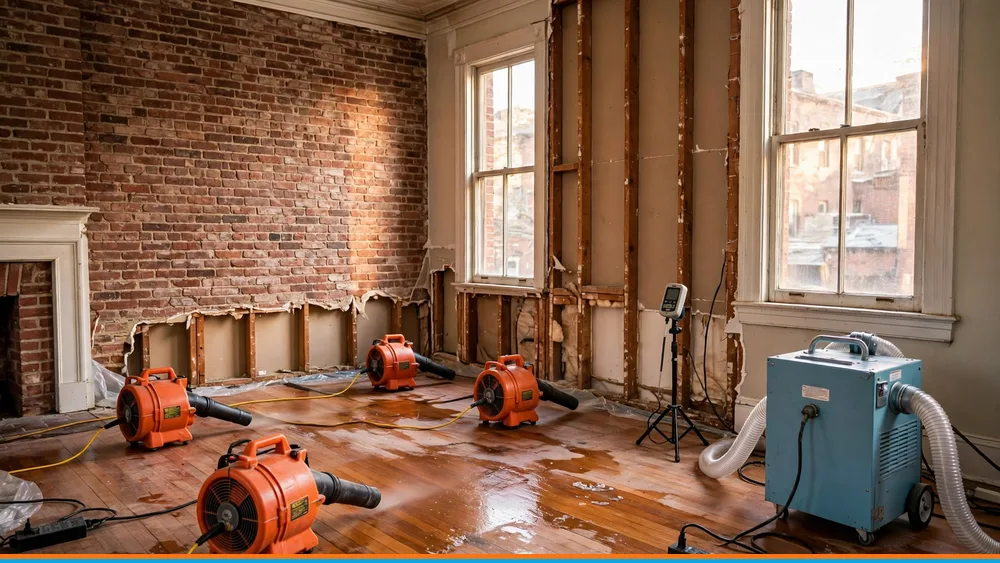
Plaster-and-lath walls, still common in older Baltimore homes, behave nothing like modern drywall. Plaster is dense, so it absorbs water slowly — but once it is wet through, it also dries slowly, and drying it too aggressively from the surface can leave the lath and the cavity behind it damp while the face feels dry. The honest method is staged: remove baseboards so air can reach the bottom of the wall, drill small weep and vent holes where the plan calls for them, and direct warm, dry air into the cavity while readings — not the calendar — say when to stop.
Hardwood deserves the same patience. Original pine and oak floors cup and crown when the underside stays wetter than the top, and specialty drying mats that pull moisture up through the boards can often save a floor that a tear-out-first approach would lose — but only if drying starts before the boards have sat saturated for days. In a rowhouse basement, add one more slow material: the brick and stone foundations of older homes wick groundwater upward, so a basement that flooded needs its walls read at several heights, not just at the waterline.
What a proper rowhouse drying job looks like, day by day
Day one is extraction and decisions: standing water out, wet material that cannot be saved — soaked carpet pad, crumbling plaster, saturated insulation — removed, and containment set so dust and drying air stay in the work area and out of the rest of a home you are still living in. Air movers are aimed to move air across wet surfaces and into opened cavities, and dehumidifiers are sized to the space and the materials, not dropped in by rule of thumb. In narrow rowhouse rooms, equipment placement is a puzzle of its own: the goal is full air movement without turning the one hallway into an obstacle course.
After that, the job is monitoring. Crews return to take readings in the same marked spots — party wall, plaster, hardwood, subfloor, basement masonry — adjust or remove equipment as materials reach their targets, and log every reading. That log does double duty: it is how we know the house is actually dry, and it is the record your carrier reviews. Most rowhouse losses reach verified dry targets in a range of days, not weeks, but plaster and brick sit at the slow end of that range and pretending otherwise is how mold gets invited back.
The neighbor question, insurance — and when to call
Two practical points are specific to attached homes. First, tell your neighbors early if water reached a shared wall: it is the courteous move, it protects their home, and if their side shows damage, both claims are stronger when the source and the timeline are documented from day one. Second, keep the paper trail a rowhouse claim needs — photos of the source, the waterline and every affected room before cleanup, the damaged section of pipe if one is replaced, and receipts for emergency work. A sudden burst or appliance failure is the classic sudden-and-accidental loss, and we produce the moisture log and itemized scope as a normal part of the job and bill carriers directly for covered work.
If your Baltimore rowhouse is wet right now — a soaked party wall in Canton, a flooded basement in Hampden, a ceiling stain spreading in Federal Hill — do not wait to see whether it dries on its own. Attached homes hide water better than any other housing stock in Maryland. Call Eagle Water Damage Restoration at (855) 809-6899 or send the lead form on this site. We answer 24/7 from Beltsville, assessments are free, and our IICRC-certified crews handle extraction, structural drying and the insurance documentation as one documented job.
Need This Handled?This guide covers Water Damage Restoration — the service behind this article. Free assessments, 24/7 response across Maryland: (855) 809-6899 or read about the service.
Water Damage Can't Wait — Neither Should You
Every hour of standing water means more damage and a bigger repair. Request your free assessment online and we'll call you back to confirm — or call now and a coordinator will dispatch a crew.